Saturday, 22 August 2015

Phrasal verbs

Phrasal Verbs


* Some verbs are made up of a verb and a preposition and have a special meaning that is different from the words they are made of.

* A phrasal verb is a verb plus a preposition or adverb which creates a meaning different from the original verb.
For example:
                            

* A list of Phrasal verbs:

Phrasal verb
Meaning
Example sentence
break down
stop functioning (vehicle, machine)
Our car broke down at the highway in the snowstorm.
break out
escape
The prisoners broke out of jail when the guards weren't looking.
calm down
relax after being angry
You need to calm down before you drive the car.
catch up
get to the same point as someone else
You'll have to run faster than that if you want to catch up with Mary.
check out
leave a hotel
You have to check out of the hotel before 11:00 AM.
cheer up
become happier
She cheered up when she heard the good news.
come forward
volunteer for a task
The woman came forward to help.
find out
discover
We don't know where he lives. How can we find out?
get back
return
We got back from our vacation last week.
grow up
become an adult
When Jack grows up he wants to be a pilot.
pass away
die
His uncle passed away last night.
take off
start to fly
My plane will take off in five minutes.
turn up
appear suddenly
Ram turned up for the movie on time.
work out
exercise
I work out at the gym twice a week.


Monday, 10 August 2015

Weekend Home Task 4

Weekend home Task 4

Change the following sentences to negative using contractions:

e.g. He bought a bag.
       He didn’t buy a bag.

1. She liked that movie.
    She didn’t like that movie.

2. She closed that door.
    She didn’t close that door. 

3. The boy falls down from the stairs.
    The boy doesn’t fall down from the stairs.

4. The thief stole our car yesterday.
    The thief didn’t steal our car yesterday.

5. They know our aunt.
    They don’t know our aunt.

6. She wants to play tennis.
    She doesn’t want to play tennis.     


Saturday, 1 August 2015

Possessive Nouns and Possessive Pronouns

Possessive Nouns and Possessive Pronouns


* Possessive nouns are nouns that show ownership (someone owns it or it belongs to someone) 

*  Possessive nouns can be singular or possessive. These are formed by adding an apostrophe and ‘s’ to a singular noun or only an apostrophe to a plural noun.
 
Examples:
A. For singular nouns add apostrophe and ‘s’
     For eg.  
1. Tina’s dress is red in colour.
2. Raj’s bicycle is new.   

B. When the noun ends in ‘s’ , we do not add the possessive ‘s’ but just put the apostrophe after the noun.
 For eg.    
1. The babies’ beds are all in a row.
2. The witches’ broom has magical powers.
 
* Nouns can be replaced by possessive pronouns such as – mine, yours, his hers, its, ours, yours, theirs. No apostrophe is used here.
For eg.    
1. Tom’s book – his book
2. The cheetah's speed - its speed 


Tuesday, 28 July 2015

Weekend home Task 3

Weekend home Task 3

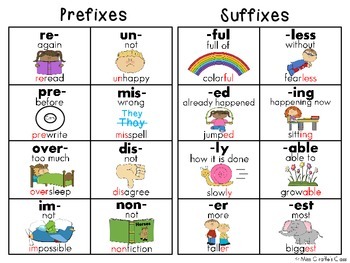
Use a prefix and suffix to make words. You may have to change some spellings.

1.   mis    place     d
2.   im   possible   e ity
3.   un   fortunate ly
4.   un   happy      y iness
5.   il        legal      ity
6.   im    mature   e ity
7.   in      active     e ity
8.   dis   connect   ion
9.   non   fiction    al

10.  un     read      able 

Monday, 20 July 2015

Phrase

Phrase

A phrase is a group of words that does not contain a verb. It does not have a subject or predicate. So it does not make complete sense.
There are several different kinds of phrases. A phrase is essentially a noun, adjective, adverb or preposition that has been expanded.

I    Noun Phrase (noun is the main part)
 A noun phrase consists of a noun and other related words which modify the noun. It functions like a noun in a sentence. A noun phrase consists of a noun as the head word and other words which come after or before the noun.

Examples.
1. He is wearing a nice red shirt.                      
2. The boy with brown hair is laughing.


II   Adjectival phrase (adjectives are used) 
An adjectival phrase is a group of words that functions like an adjective in a sentence. An adjective phrase functions like an adjective to modify (or tell about) a noun or a pronoun in a sentence.

Examples.
1. He is wearing a nice red shirt.                   
2. The girl with brown hair is singing a song.
                                                                               

III   Adverbial phrase (adverbs are used)
 An adverbial phrase is a group of words that functions as an adverb in a sentence. An adverb phrase functions like an adverb to modify a verb, an adjective or another adverb.

Examples
1. He always behaves in a good manner.

2. They were shouting in a loud voice.    

Friday, 17 July 2015

Weekend home Task 2

Weekend home Task 2


Underline the adverbs and change it to its opposite in the blank:

1. Finally, he wrote the last chapter of the book. firstly

2. Sujata looked excitedly at her new birthday present. unhappily

3. I quickly moved to another room. slowly

4. Rajesh began to sing softly at the party. loudly

5. The rain fell heavily on the green fields. lightly

Saturday, 11 July 2015

Abstract nouns

Abstract nouns
                       

An abstract noun is a word which names something that you cannot see, hear, touch, smell, or taste. They are not objects but names given to qualities, attitudes or feelings.

It is the opposite of a 
concrete noun (that which can be felt, thought and seen).

Abstract nouns are uncountable nouns.
 For example : love, happiness, anger, pride, friendship, etc.

A lot of abstract nouns generally end in the following:
-ness : graciousness, helplessness, homelessness
-ity : humility, charity, audacity
-tion : communication, sophistication, satisfaction
-ment : encouragement, contentment, disappointment
-sion : compassion, apprehension, impression
-ence : confidence, intelligence, prominence

Abstract nouns in sentences:
1. The education of children should be our number one priority.

2. He was willing to sacrifice his job in order to move to Hawaii.

3. Childhood memories are sources of great joy.

4.  Music can change a mood or be a creative outlet.